Appropriations Update
As reported in a March 23 blog, Congress is proceeding with its Fiscal Year (FY) 2027 deliberations. The House Appropriations Committee is tentatively expected to consider or “mark up” its version of the FY 2027 Commerce, Justice, Science (CJS) Appropriations bill, which funds the Census Bureau, in subcommittee on May 7 and full committee on May 13. The Senate Appropriations Committee has not announced a formal markup schedule; however, it has announced deadlines for member submissions. The Senate CJS Appropriations Subcommittee deadline is Tuesday, April 14.
As a reminder, The Census Project has tips for stakeholders to submit appropriations requests to Senators’ portals.
In related news, 44 members of the U.S. House of Representatives sent the House CJS Appropriations Subcommittee a bipartisan Dear Colleague letter requesting $2.1 billion for the Census Bureau in FY 2027, led by Representatives Judy Chu (D-CA-28) and Gil Cisneros (D-CA-31).
The Census Project Releases Fiscal Year 2027 Funding Recommendation
On March 27, The Census Project released the details of its Fiscal Year 2027 funding recommendation. The document, which was informed by input from The Census Project Advisory Committee, recommends that the Census Bureau receive $2.1 billion in FY 2027 to support 2030 Census preparations, enhancements to the American Community Survey, investments in the Population Estimates and Geographic Support Programs, and funding to maintain, while innovating, the Survey of Income and Program Participation.
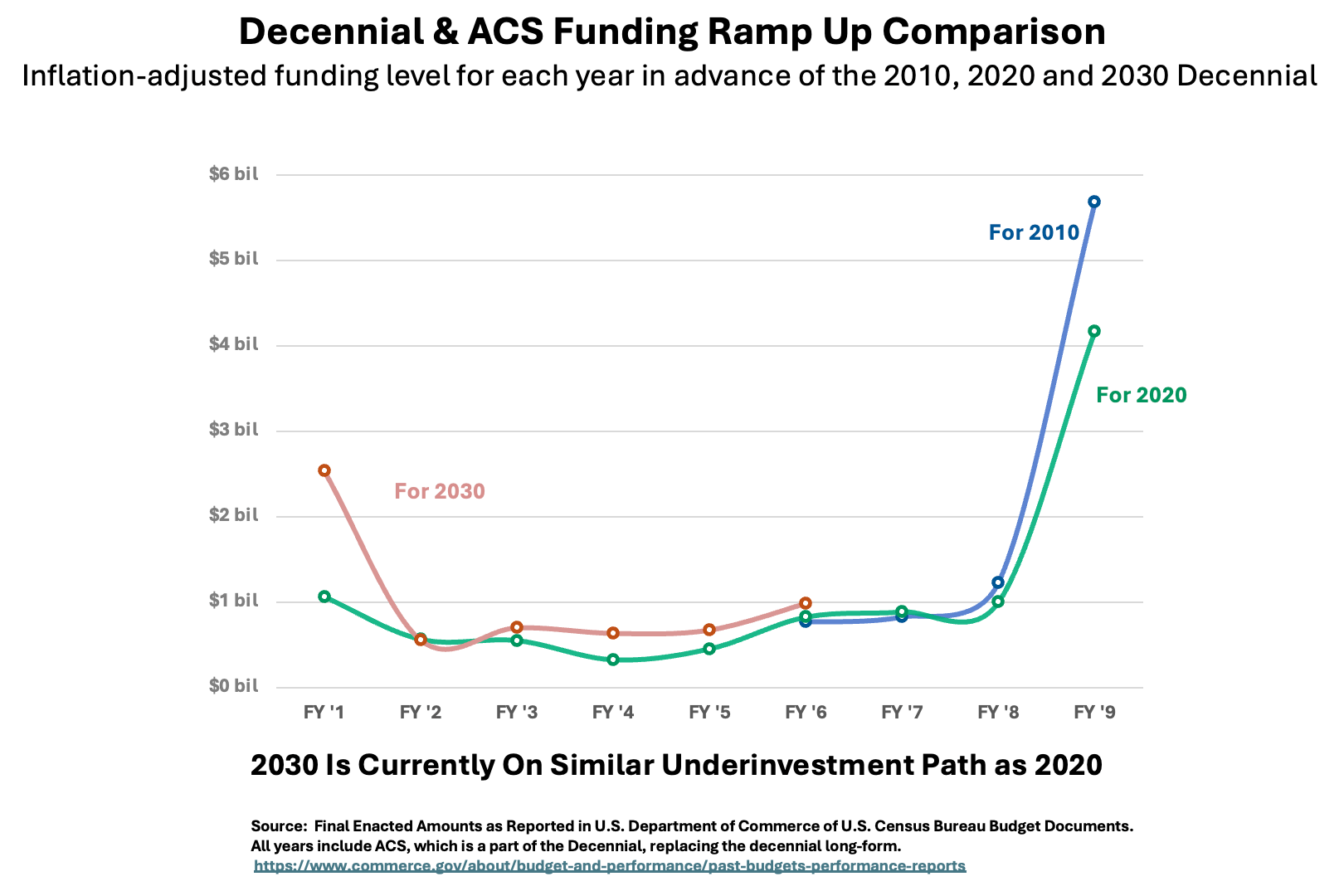
The recommendation also features a new graph (see below) comparing inflation-adjusted funding cycles for the 2010, 2020, and 2030 censuses. The graph illustrates that funding for the 2030 Census is currently on the same underinvestment path experienced at this point in the last decade in the ramp up to the 2020 Census.
Policy Update
Census Stakeholders Respond to Final Plans for 2026 Census Test
On March 23, the Census Bureau announced its final operational plans for the 2026 Census Test. The announcement confirmed the agency’s plans to eliminate all but two of the originally six proposed sites and test the use of postal carriers as enumerators. Several census stakeholder organizations expressed disappointment and concern about the outcome despite the hundreds of comments that the Department of Commerce and Census Bureau received urging them to restore the test’s original design. The test is scheduled to begin May 1.
March Standard Deviations Blog Features Report on Federal SOGI Data Landscape
On March 3, The Census Project published a Standard Deviations blog, “LGBTQ Data at the Census Bureau: What’s Changed and Why it Matters.” Authored by Caroline Medina of the Movement Advancement Project (MAP), it featured findings from MAP’s recent report, “The Federal SOGI Data Landscape Under the Second Trump Administration: One Year in Review.” The Census Project sponsors the Standard Deviations series to provide census stakeholders with an opportunity to share their news and views (not necessarily endorsed by The Census Project).
Census Bureau Announces Changes to Rules on Special Censuses and Programs
In a March 11 blog, The Census Project shared news that rules on special censuses and programs have been simplified, effective February 20, 2026. Per the Federal Register Notice, “By this rule, the Census Bureau is amending its regulations governing requests and establishing fee structures for special census services and studies.” The announcement goes on to state that “this action is necessary to eliminate obsolete provision and streamline the Census Bureau’s regulations” and “promote simplicity and efficiency and to reduce the possibility of public confusion.”
Bills Introduced in Congress Address Redistricting and Prison Gerrymandering
In March, The Census Project highlighted two recently introduced bills:
- Fair Apportionment and Independent Redistricting for Maps that Avoid Partisanship Act (FAIR MAP Act) (H.R. 7219)—The bill, which was introduced by Representative Mike Lawler (R-NY-17), sets requirements for redrawing congressional districts, prohibits states from using ranked choice voting in federal elections, requires photo ID or signature verification for voting in Federal elections, and prohibits same-day voter registration for federal elections. It was referred to the House Judiciary, Oversight and Government Reform, and Administration Committees for further consideration.
- End Prison Gerrymandering Act (H.R. 7375)—The bill, which was introduced by Representative Deborah Ross (D-NC-2), would require that people in prison, for purposes of a decennial census, would be counted at their last usual place of residence before incarceration. H.R. 7375 was referred to the House Judiciary and Oversight and Government Reform Committees for further consideration.
House Oversight and Government Reform Committee Seeks Extensive Census Details
On March 24, Representative James Comer (R-KY-1), Chairman of the House Oversight and Government Reform Committee, sent a letter to Acting Director of the Census Bureau George Cook requesting documents related to the results of the 2020 Census, including the 2020 Census Post Enumeration Survey. The complete letter and additional details are available in The Census Project’s March 27 blog.
Independent Census Scientific Advisory Committee Holds Spring 2026 Meeting
On March 26, the Independent Census Scientific Advisory Committee (I-CSAC) held its Spring 2026 meeting. The meeting materials, including a video of the meeting’s complete proceedings, are available on the I-CSAC home page. In addition to receiving presentations on a variety of topics, including revisions to the Vintage Population Estimates methodology and The Race/Ethnicity Coding Improvement Project, I-CSAC also issues several recommendations including a unanimous vote to fully restore the original design of the 2026 Census Test.
Requests for Public Comments
Throughout March, The Census Project published several blogs, highlighting requests for public comments that may be of interest to census stakeholders:
- Through April 20, the Census Bureau is accepting public comments on its Local Update of Census Addresses (LUCA) operation. In a March 13 blog, The Census Project noted that the Federal Register Notice (FRN) highlights “multiple new tools to assist participants with conducting their work, such as an address matching service, web-based tools that eliminate the need for the download of software, and a secure portal to facilitate communication and registration.”
- In a March 12 blog, The Census Project shared an opportunity to submit comments on the Current Population Survey (CPS) 2026 Field Test. The comment opportunity, which closes May 4, 2026, allows the public to provide feedback on the agency’s plans to test an internet self-response method.
Census Bureau Releases
On March 16, a Random Samplings blog, “Updating the Planning Database With the 2020 Census Contact Strategy and Low Response Score,” was released. The blog, which was authored by Census Bureau officials, Anthony Knapp, Demographer, and Benjamin Gurrentz, Survey Statistician, explains the purpose of the Census Planning Database and Response Outreach Area Mapper and recent innovations to these tools.
In a March 26 release, the Census Bureau reported that population growth slowed in most of the nation’s 3,143 counties and the District of Columbia between July 1, 2024, and July 1, 2025. The news was based on data from the Vintage 2025 Population Estimates.
On March 12 and March 26, the Census Bureau released new data products from the Business Trends and Outlook Survey (BTOS), a survey that measures business conditions and projections on an ongoing basis.
Household Trends and Outlook Pulse Survey data were released on March 26.
The final operational plans for the 2026 Census Test were announced in a March 23 press release. The release focuses on plans that the Bureau announced to test the use of postal carriers as enumerators in Spartanburg, South Carolina and Huntsville, Alabama. The test will begin May 1.
On March 19, the Bureau announced the launch of USA Trade Online: Reimagined and transition from the legacy USA Trade Online (UTO) platform.
The February 2026 Business Formation Statistics were released on March 19.
In a March 5 press release, the Census Bureau shared new data tables for the Annual Survey of State Government Finances. These statistics provide a summary of the finances of state governments for fiscal year 2024.
News You Can Use
Below are several articles posted on The Census Project home page in March 2026. For a complete listing, go to: 2026 Media – The Census Project. (News media coverage is not necessarily endorsed or supported by The Census Project but is provided to give census stakeholders a wide spectrum of views and materials.)
Where the U.S. Is Growing—and Shrinking—in Charts
The Wall Street Journal
March 27, 2026
Far fewer immigrants are moving to big cities in U.S., data shows
The Washington Post
March 26, 2026
Key findings about Black immigrants in the U.S.
Pew Research Center
March 20, 2026
When disaster strikes, census data can help show who is in harm’s way
NextGov/FCW
March 16, 2026
Who we count shapes how we measure housing supply and affordability
Brookings
March 3, 2026